
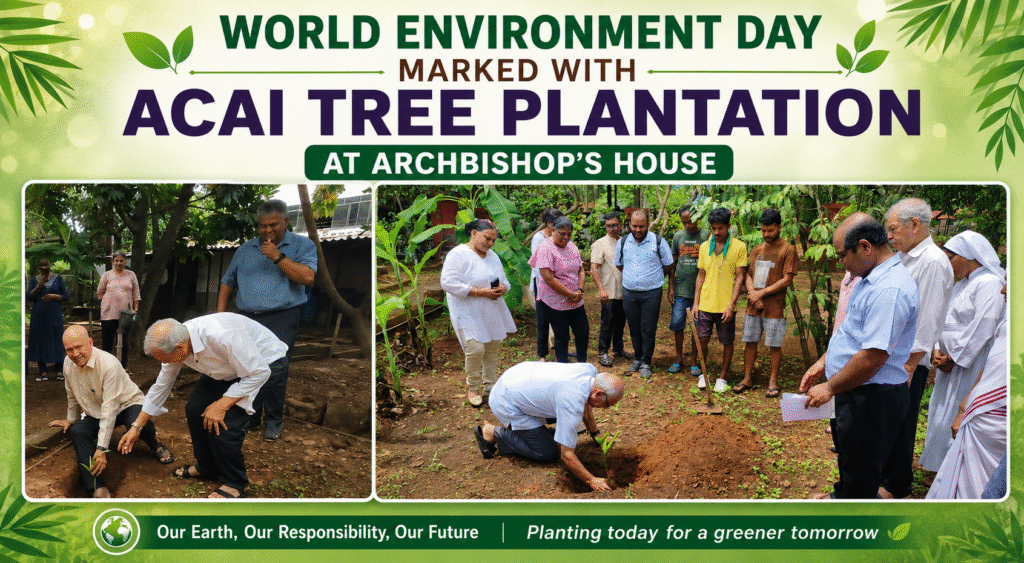
To mark World Environment Day on 5th June 2026, His Eminence Cardinal Filipe Neri Ferrao and Auxiliary Bishop Simiao Fernandes, together with the staff of the various offices at the Archbishop’s House, took part in a special tree-planting ceremony by planting an Acai tree as a symbol of care for creation.
Native to the Amazon rainforest, particularly in Brazil, the Acai palm is renowned for its small dark purple fruits that are rich in antioxidants, healthy fats, and other essential nutrients. Widely recognized for its environmental and nutritional significance, the Acai tree thrives in tropical conditions and symbolizes the importance of preserving nature and promoting sustainable living.
The plantation ceremony served as a meaningful reminder of the collective responsibility and commitment to environmental stewardship and to care for our common home for future generations.
Information of Acai Tree
Acai is a small, dark purple fruit from the acai palm tree, native to the Amazon rainforest, especially in Brazil. It has a unique earthy and slightly bitter taste, often described as a mix between berries and chocolate, and is known for its high nutritional value and antioxidant properties. While traditionally eaten as a puree with meals by indigenous communities, it is now popular worldwide in smoothies, bowls, and juices, often with added sugar to make it sweeter.
Characteristics and taste
Appearance: A small, dark purple fruit that grows in bunches on the acai palm tree. It looks similar to a blueberry but has a large seed inside and a thick skin. auch
Flavour: Naturally, it has an earthy, fatty taste, with a bitterness that is sometimes compared to an avocado. It is not inherently sweet.
Texture: The pure, unadulterated pulp has a pudding-like texture.
Nutritional value: Acai is rich in antioxidants, healthy fats, and polyphenols.
Traditional and modern uses
Traditional: In the Amazon, especially in the state of Pará, acai is soaked, mashed into a puree, and eaten as a staple with meals like fried fish.
Modern: The fruit is exported globally as a frozen puree, dried powder, or juice. It is a popular ingredient in the West for acai bowls, smoothies, and sorbets, which often have sugar added to make them sweeter.
Cultivation and origin
Origin: It is a fruit of the acai palm, a tree that grows widely in the Amazon river basins of Central and South America.
Primary producer: The Brazilian state of Pará is the world’s largest producer, responsible for approximately 85% of global acai production, with the village of Igarapé-Miri known as the “world capital of acai”.
Growth conditions: The palm thrives in hot, humid tropical conditions and is often found in waterlogged or flooded areas.