
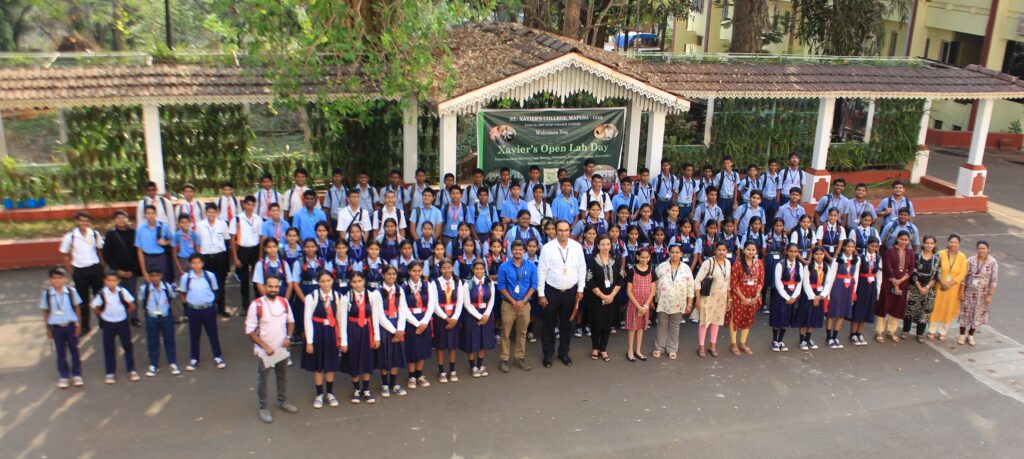
St. Xavier’s College, Mapusa, as part of its National Science Day celebration, hosted an Open Lab Day on 17th March 2026 to inspire interest in higher science education. The event welcomed over 200 students from various high schools and higher secondary schools across Goa. By providing access to undergraduate-level laboratories and facilities, the program successfully bridged the gap between classroom theory and practical application through direct interaction with faculty and college students.
The day featured a diverse array of hands-on demonstrations spanning multiple scientific disciplines. In the tech and electronics sectors, students observed a Fire Fighting Robot designed to autonomously detect and extinguish small fires using sensor-based control, an innovative Deep Learning System for detecting adulteration in black pepper powder. Students engaged with a Gesture-Based Sound System, a proximity-sensing Smart Dustbin, and an IoT-based Rock-Paper-Scissors Robot. Modern computing was showcased through “Virtual Advocate,” an AI-driven legal platform, and “Kitchen Bash,” a Python-based game used to teach core programming concepts.
Mathematical and physical principles were brought to life through The Chaos Game, the Monty Hall Problem, and demonstrations of electromagnetic waves and high-powered telescopes. Biological and chemical sciences were equally represented with interactive experiments that captivated the young audience. Students participated in creating synthetic blood for forensic analysis and performed DNA extraction from bananas, tomatoes, and onions, later visualizing the results under a UV transilluminator. Models of prokaryotic and eukaryotic cells were on display besides corals, fossils and student made terrariums to emphasize sustainability & creativity. Chem Hang Man was a fun filled interactive game to test the Chemistry Vocabulary of participants.
These activities were hosted by the departments of Biotechnology, Physics, Chemistry, Mathematics, Microbiology, Botany, Computer Science, and Electronics. The feedback from participants was overwhelmingly positive. Students Diya, Khushi, and Kraig described the experience as enriching and well-explained, expressing a strong desire for future events. Teachers accompanying the students specifically thanked the college management, noting that the “fantastic” presentations allowed their students to finally relate textual concepts to live experiments. Ultimately, the initiative left a lasting impression, successfully fueling scientific curiosity in the future generation of learners.